
What is sentence mining?
Sentence mining is a highly effective language-learning technique where you collect complete, natural sentences from real-world media rather than memorizing isolated vocabulary lists. It isn’t clear where the term “sentence mining” came from, but it seems to have emerged from online language-learning communities as people experimented with immersion-based methods.
A bit of history on sentence mining
It’s actually online Japanese-learning communities that pioneered a lot of the new immersion-based approaches. Before the term sentence mining existed, a popular framework known as “AJATT” (All Japanese All The Time) was popularized in the mid-2000s. Created by Khatzumoto, he emphasized that recreating a target-language environment wherever they lived was optimal for attaining fluency. This was to be achieved through full-time language immersion through media (TV, comics, labeling your surroundings, listening to native content, etc.). This immersion was complemented with spaced-repetition flashcards mined from Japanese materials to reinforce vocabulary and grammar comprehension.
This concept inspired a large number of online communities, learners, and polyglots alike to focus on “input-based learning”. Khatzumoto was able to achieve workplace fluency and acquire a job at a Japanese company within ~18 months of study using his method.
AJATT went on to inspire derivative frameworks, most notably MIA (Mass Immersion Approach) popularized by Matt vs Japan, where sentence mining as a concept began to root itself.
The textbook problem
There are several fundamental issues with how textbooks try to teach language learners — not necessarily because the content is bad, but because the content is forced to be structured in a way that is unnatural for acquiring languages.
The biggest problem with textbook learning is that it optimizes for organization, without any malleability. Unfortunately, this is not how humans naturally acquire language — being able to recognize vocabulary and grammar structures alongside generic sentences does not mean you’re then able to actively recall it and use it in real scenarios.
For the most part, textbooks build up your passive vocabulary, which consists of words you can recognize and understand when encountered (i.e. in reading or listening), but you wouldn’t naturally produce yourself. The words that you can deploy naturally in real-world scenarios are known as active vocabulary, and are built through repeated, pressured retrieval. Most people’s passive vocabulary is 3–5x larger than their active vocabulary.
Another related issue with textbooks is that the inputs are artificial and decontextualized — optimized for understanding specific vocabulary and grammar, while sanitized from the messiness that makes language meaningful. For example, the sentence “Alice and Bob went to the supermarket” has no meaningful connection to the learner, while historical research argues that acquisition happens best through comprehensible, contextually rich exposure over controlled exercises (more on that later).
In short: textbooks alone aren’t enough and should be supplemented with immersion.
What the research actually says
Comprehensible input and the i+1 principle
One of the most influential concepts in language acquisition is Stephen Krashen’s theory of comprehensible input. He argued that language is best acquired when you’re exposed to input you can mostly understand, with just enough new information to extend your knowledge. Commonly referred to as i+1, the input is slightly beyond current ability.
Sentence mining falls under this category pretty clearly. From a variety of content, you’re constantly cherry-picking bits and pieces you struggle to understand, then trying to make sense of them, building upon your current foundation. While textbooks and courses can also support comprehensible input, there is plenty of other research that they cannot be tied back to…
Contextual learning and encoding specificity
Another big breakthrough that re-defined our understanding of human memory was Endel Tulving’s principle of encoding specificity (AKA context-dependent memory). Tulving found that memories are easier to retrieve when the conditions at retrieval (what you’re currently recalling) reflect the conditions at encoding (when you originally learned something). For instance, studying in the same room where an exam is taken would help you recall material more easily when the exam actually happens. Similarly, recall of information learned while intoxicated becomes easier when intoxicated again.
Essentially, the concept of encoding specificity is exactly why you can drill a word hundreds of times from the comfort of your room but still blank on it mid-conversation; the retrieval conditions don’t match the encoding. The fix isn’t just more reviews, it’s immersive learning. When you pick up the word for a specific type of sashimi at a restaurant, the next time you see that sashimi on the menu, you’ll be much more likely to recall it again.
Depth of processing
Known for his work on second-language acquisition and language cognition, Jan Hulstijn studied why some words are remembered better than others. He came up with the idea that the amount of mental effort invested during learning affects retention, and that learners recall words better when they’re processed with greater cognitive effort and contextual engagement.
Sentence mining fits this bill perfectly, as the technique forces learners to engage with syntax, meaning, surrounding context, and usage rather than pure word-to-translation.
Spacing and active recall
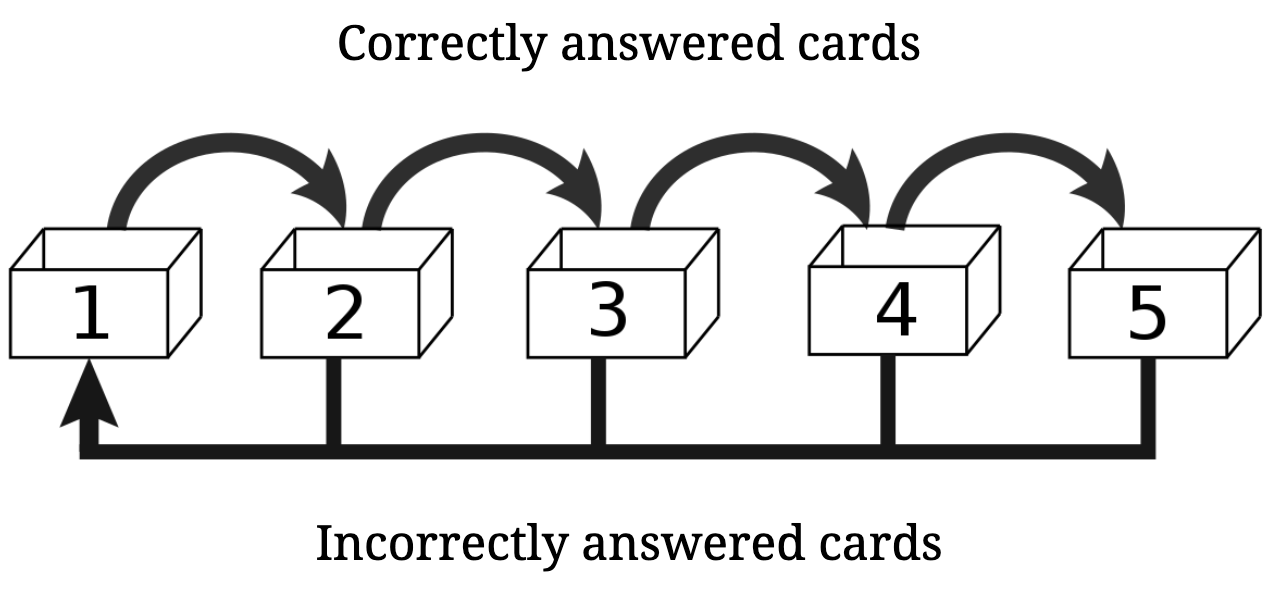
It is well known that spaced repetition is one of the strongest findings in memory science. Tatsuya Nakata studied how review schedules affect retention, specifically the nuances around cramming, equal spacing, and expanded spacing. He found that distributed practice consistently outperforms massed practice, whether reviews are equally or increasingly spaced.
As a large part of the sentence mining workflow revolves around studying flashcards with spaced repetition, the benefits here are pretty clear.
Other research
We’ve only just scratched the surface of scientific language-acquisition and memory research, though arguably these are the most relevant here to sentence mining. If you’re still not convinced, here’s some more research to read up on:
- Levels of Processing Theory by Fergus Craik and Robert Lockhart: Information processed for meaning is remembered better than information processed superficially.
- Incidental Learning by Stuart Webb: Picking up words naturally through reading, listening, and watching is a primary driver of vocabulary growth, and builds richer, more contextual word knowledge than studying words in isolation.
- Deliberate Vocabulary Study by I. S. P. Nation: Intentional study like flashcards complements incidental learning by training you to notice target words when they appear in real input, speeding up acquisition.
How to start (without overthinking it)
For a concept that seems so simple, the sentence mining rabbit hole goes deep. Online communities have distilled and optimized the process as much as possible, and there are now dozens of different tools, software, and methods to reduce the workflow friction. But if someone asked me how to start sentence mining today, I’d start with the following:
- Watch YouTube in your target language
- Find one sentence you mostly understand
- Screenshot/copy it
- Save it (notes app, spreadsheet — your preferred method of notetaking)
- Look at it again tomorrow
It essentially breaks down into noticing something you don’t know, saving it, and re-encountering it later. However, if you’re a nerd who loves to min-max their learning, you can start looking into techniques like the Yomitan/Anki combo (for Japanese), and tools like Migaku/LingQ.
Gravity loves sentence mining :)
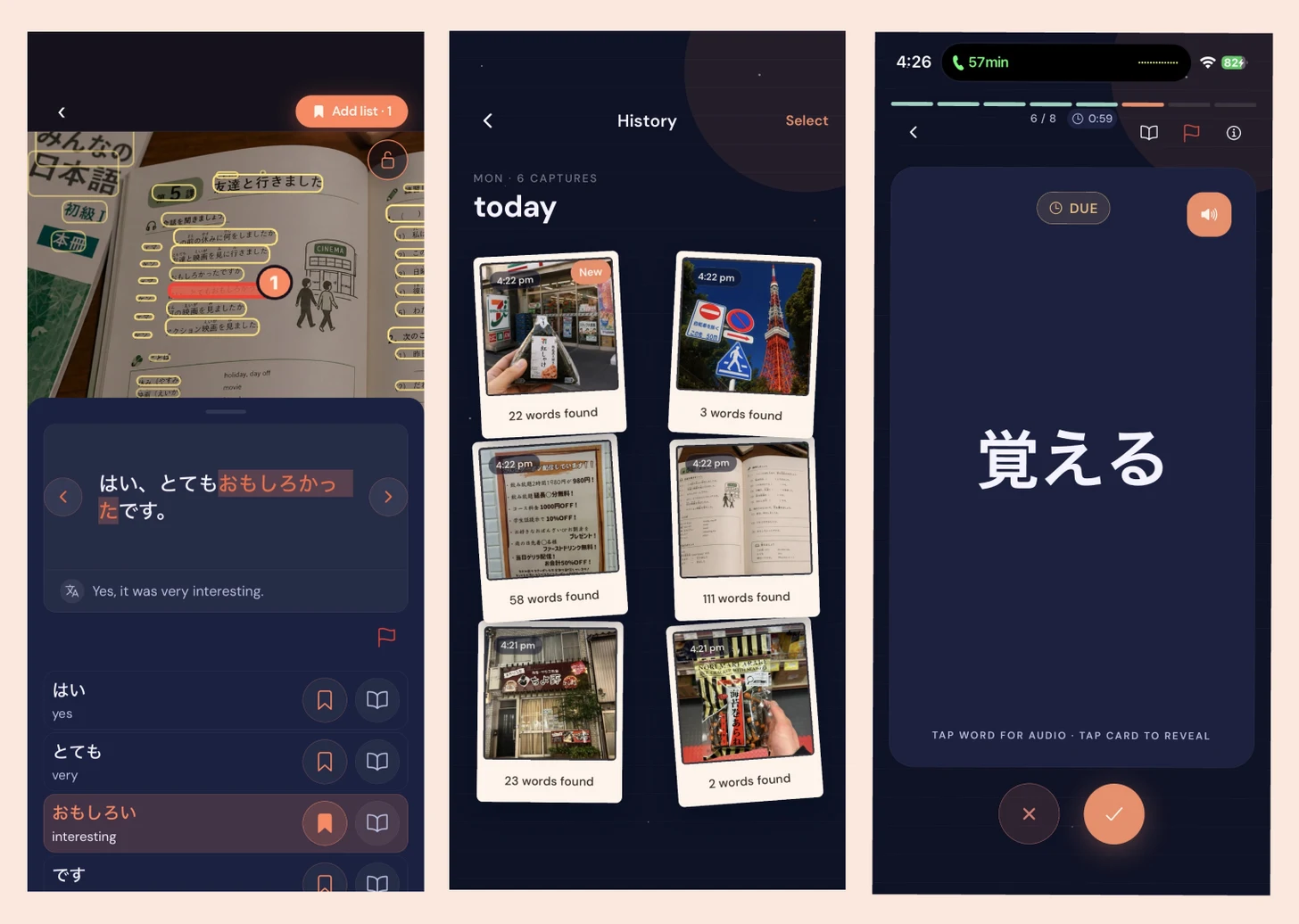
As the team behind Gravity, we believe that sentence mining works and is one of the most effective ways to acquire language in a relatively short period of time. However, we also understand that there are no shortcuts to the process. The problem is that sentence mining often comes with a surprising amount of manual work. We’re aiming to reduce that friction by turning real-world Japanese (and soon many other languages!) into study material automatically, while tracking what you’ve seen, learned, and repeatedly encountered over time. Instead of managing flashcards, dictionaries, screenshots, and notes across multiple tools, learners can focus on the part that matters most: engaging with the language itself.
Final remarks
It’s a shame that more people still don’t know about the modern tools and workflows that can get you much farther in a shorter amount of time. Why go through the pain of sitting down and slogging through a textbook when you already have everything you need to learn most effectively (i.e. immersive content, spaced-repetition tools, flashcard builders)? As research and tools for language acquisition continue to improve, it’s clear that this is still a non-optimized problem.
With Gravity, we’re striving to solve it.
Feel free to come along for the ride.